Architecture is a series of bets, not a lookup
An AI can generate a component, a service, an entire scaffolded application. What it cannot do is decide whether that application should exist in the shape you are imagining. Architecture is not a retrieval problem with a correct answer waiting to be surfaced; it is a series of bets made under uncertainty about a future nobody can see clearly.
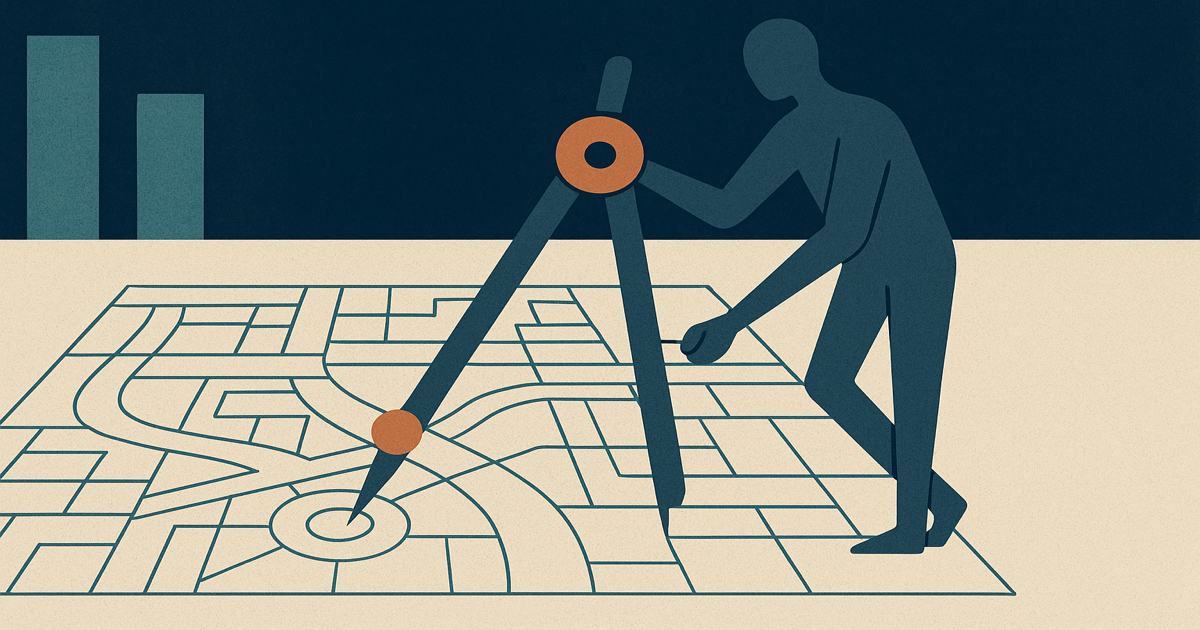
Should this be one service or three? Where do you draw the boundaries so that the changes you will need next year are cheap instead of catastrophic? Which constraints are worth honoring and which are cargo-culted habits? What are you deliberately choosing not to build? These questions require holding the whole system, the business context, and a plausible future in your head at once, and then committing to a direction knowing you might be wrong. A model can propose options and articulate tradeoffs—genuinely useful, and we use it that way. But the act of choosing, and owning the consequences of the choice, is human. The compass draws the line; someone still has to decide where the city goes.
Product judgment lives upstream of any prompt
Most software fails not because it was built badly but because the wrong thing was built well. AI is spectacularly good at building things. It has no opinion whatsoever about whether the thing is worth building.
Deciding what to build is an act of judgment soaked in context a model does not have: who the users actually are versus who they say they are, what the business can sustain, which corners are safe to cut and which will quietly metastasize, what "good enough" means for this product at this stage. These calls get made in the ambiguous space upstream of any prompt, and they are frequently the difference between a product that matters and a beautifully engineered answer to a question nobody asked. You can hand a model a crisp specification and receive excellent code. Producing the crisp specification—translating a vague human need into something buildable—is the hard, human part, and it is not getting automated because it is barely even a coding problem.
Security and correctness need an adversarial mind
We covered in this series how AI-generated code looks finished before it is trustworthy. The counterweight to that is a distinctly human posture: the adversarial imagination that asks how this breaks, who would want to break it, and what happens on the day everything that can go wrong does.
Models are trained to be helpful, which is a lovely quality in a colleague and a liability in a security reviewer. They pattern-match toward the plausible and the cooperative, not toward the paranoid. Real security thinking means modeling an intelligent adversary who is actively hostile to your intentions—reasoning about trust boundaries, failure cascades, and the creative misuse a determined attacker will attempt. Interfaces like the Model Context Protocol are expanding what agents can reach and do, which makes this human vigilance more important, not less: the more capability you wire up, the more carefully someone has to reason about what could be abused. That someone is still a person with a suspicious mind and something at stake.
Ambiguity is the human's home turf
Give an AI a well-defined problem and it excels. Give it a genuinely ambiguous one—conflicting requirements, missing information, stakeholders who want incompatible things and have not admitted it yet—and it will do what it always does: produce a confident answer to whichever interpretation it landed on, with no signal that it chose.
Navigating ambiguity is arguably the core of senior engineering. It means knowing which questions to ask before writing a line, recognizing when a requirement is quietly impossible, sensing when the stated problem is not the real one. A model does not know what it does not know; it does not experience the productive discomfort of "something here does not add up." Humans do, and that discomfort is a feature. It is the alarm that stops you building the wrong thing well.
Accountability cannot be delegated to a model
This is the one that resolves all the others. When software fails—when it leaks data, loses money, or makes a decision that harms someone—a human being is accountable. Not the model. Not the vendor. A person, or a company full of them.
You cannot delegate accountability to something that cannot be accountable. A model has no stake in the outcome, no reputation to protect, no obligation to the people the software affects, and no capacity to care whether it was right. Those are not incidental gaps; they are the entire basis of professional engineering. The reason we insist on human review, independent verification, and clear ownership is not nostalgia for how things used to be done. It is that responsibility has to live somewhere, and it can only live with an entity capable of bearing it. The tools change; that constant does not.
Our point of view at Chapter Two
We are optimists about AI in engineering, which is exactly why we are precise about its limits. The teams that will do the best work over the next decade are not the ones optimizing only for labor reduction, nor the ones treating AI as a toy to be kept at arm's length. They are the ones who understand the division of labor: let the machines handle the generation, and concentrate scarce human judgment on architecture, product, security, ambiguity, and accountability—the work that was always the point.
This is not a consolation prize for humans. It is a promotion. AI is pulling engineers up the value chain, away from the typing and toward the thinking, and the engineers who thrive will be the ones who lean into judgment rather than clinging to keystrokes. Documentation for the leading platforms—from Anthropic to Google's Gemini—increasingly frames these tools as amplifiers of capable engineering, with people remaining responsible for outcomes. We think that framing is correct, and we build our practice around it.
What This Looks Like in Practice
On our engagements, the human-machine boundary is drawn deliberately, not by accident. Machines generate; humans decide. An agent produces implementation candidates at speed; a senior engineer owns the architecture those candidates live inside. The model drafts; a person defines what the product should even be. Generated code is fast; the security review that asks how it breaks is human and adversarial by design. And at every gate, someone specific is accountable for the result—not a tool, not a process, a person.
The effect is that our best engineers spend less time on mechanical work and more on the decisions that actually move outcomes. That is the operating model we help clients build: not fewer humans doing the same work faster, but the same humans doing higher-value work, with machines carrying the load that never deserved a person's full attention in the first place.
Common Mistakes
- Treating architecture as an AI lookup. It is a bet made under uncertainty, and someone has to own being wrong.
- Automating the build before deciding what to build. Great execution of the wrong idea is still failure.
- Trusting a helpful model to think adversarially. Security needs a suspicious human mind, especially as agent capabilities grow.
- Expecting a model to flag its own uncertainty in ambiguous work. It will answer confidently regardless; humans catch what does not add up.
- Pretending accountability can be delegated. Responsibility can only live with an entity capable of bearing it.
This series began with a simple word—vibecoding—and ended somewhere more durable: a working understanding of what AI changes and what it does not. Speed is now abundant; judgment is not, and that scarcity is where the real work lives. The next series turns from the vocabulary of AI-native development to the practice of building teams around it—how roles, rituals, and evidence change when agents and humans share the workload. The tools are only as good as the operating model around them, and that is where we go next.